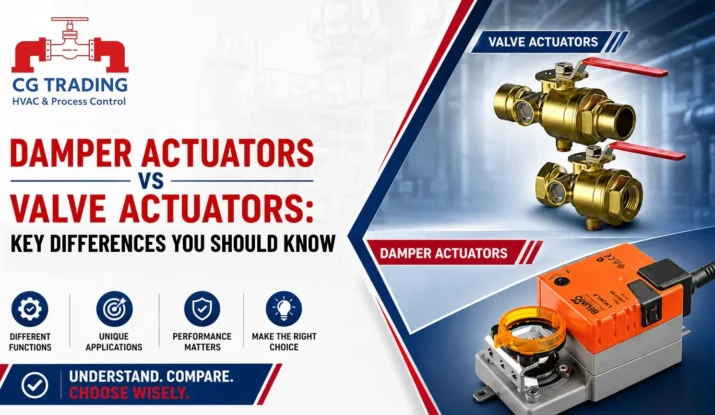
If you are setting up or upgrading an HVAC system, you would have come across two terms that sound similar but perform very different functions: Damper Actuators and valve actuators. Mixing up the two, or assuming that one can stand in for the other, can throw off the performance of the entire system. In this blog, we at CG Trading explain what separates the two, so that you may choose the right one for your setup with confidence.
Table of Contents
Introduction
Both types of actuator perform the same basic function at heart. They convert an electrical or pneumatic signal into mechanical movement. That, however, is where the similarity ends. One controls airflow, and the other controls fluid flow, and this difference in what they are moving changes everything about how they are built, sized, and installed. As you would agree, getting this right matters more than most people realise. The wrong actuator fitted on the wrong component can leave your entire HVAC system working against itself, with rooms that never reach the desired temperature and equipment that wears out sooner than it should.
What Are Damper Actuators
Damper Actuators are devices that open, close, or modulate air dampers inside ductwork. As a Damper Control Actuator, the unit rotates a shaft connected to the damper blades, adjusting how much air passes through a duct at any given time. This rotary motion is usually limited to 90 degrees, which is all a damper blade requires to swing fully open or fully shut, and it is this limited range that keeps the design simple.
Most of these units run on either 24V or 230V power supply, and many now come fitted with built-in feedback signals, so that building management systems are aware of the exact position of the damper at all times. Kindly note that this feedback function has become increasingly standard in newer models, and it is worth confirming with your supplier whether the unit you are considering includes it.
What Are Valve Actuators
A Control Valve Actuator, in contrast, is built to control the flow of water, steam, or other fluids through a valve. Instead of adjusting a duct, it opens or closes a valve seat that regulates flow through a pipe. Depending on the valve type, this motion may be rotary or linear, unlike the mostly rotary motion typically used on the airflow side.
Valve actuators also tend to work against considerably higher pressures than their damper counterparts, since they are pushing against fluid rather than air. This difference in force is why valve actuators are typically built with stronger internal components to withstand the added resistance, and it is also part of the reason they often cost more per unit.
Key Differences Between the Two
Here is where the two types diverge in practical terms. We have set this out plainly below, as a side-by-side view makes the differences easier to follow than a long paragraph would:
- What they control. Damper actuators manage airflow through ducts, while valve actuators manage fluid flow through pipes.
- Motion type. These units use rotary motion almost exclusively, whereas valve actuators may use rotary or linear motion, depending on the valve.
- Force required. Valve actuators generally require greater torque or thrust to work against fluid pressure.
- Mounting. One is mounted directly onto a damper shaft, while the other is mounted onto a valve stem or spindle.
- Common applications. One is commonly used in ventilation systems, and the other in heating and cooling loops.
Kindly note that some manufacturers use similar housings for both types, so it is always worth checking the spec sheet before finalising your order. A quick look at the torque rating and the motion type listed will usually confirm which category a given unit belongs to.
Where Each One Is Used
An HVAC Damper Control setup relies on damper actuators throughout the ductwork, adjusting airflow to different zones of a building as per temperature and occupancy requirements. You will typically find them fitted in:
- Zone dampers, for multi-room temperature control.
- Fresh air intake and exhaust dampers.
- Fire and smoke dampers, for safety compliance.
- Mixing boxes, where fresh and return air blend.
Valve actuators, meanwhile, are used wherever fluid requires regulation, such as chilled water valves, heating coil valves, and steam control valves in boiler systems. An HVAC Damper Actuator and a valve actuator may well sit just a few feet apart in the same plant room, each performing a completely different function, and each requiring its own maintenance schedule and spare parts.
Choosing the Right Actuator for Your System
Choosing between the two is not really a decision you need to make, as the application itself decides it for you. What does require deciding is the specific model within each category. For damper actuators, do consider the torque needed to move your damper blades, the duct size, and whether spring return is required for fail-safe closing. For valve actuators, do consider the valve size, the pressure it operates under, and whether modulating or on/off control suits your setup better. Getting these details right at the outset saves you from a costly replacement later on.
An Electric Damper Actuator remains the most common choice for standard HVAC ductwork these days, on account of its simple wiring and reliable feedback options. At CG Trading, we assist facility managers and contractors in matching the right actuator to the right application, rather than recommending a generic solution across every job.
Should you be planning an HVAC upgrade or setting up a new system, do get in touch with our team at CG Trading. We would be glad to help you select actuators suited to your exact requirements. Kindly reach us at cgtrading.co.in, and our team will assist with specifications and pricing at the earliest.