
Quick Summary
A digital room thermostat keeps a room at your set temperature by switching a heater, air conditioner or fan coil unit on and off. Choosing the wrong product or supplier can mean uneven comfort, higher power bills and frequent replacements. Before you buy, check the application, accuracy, relay rating, features, build quality, installation fit and the supplier’s support. Look for a reputed supplier and ask for product samples, warranty and support, and watch for red flags such as unclear specifications. Correct placement then keeps the readings accurate.
Table of Contents
What Is a Digital Room Thermostat?
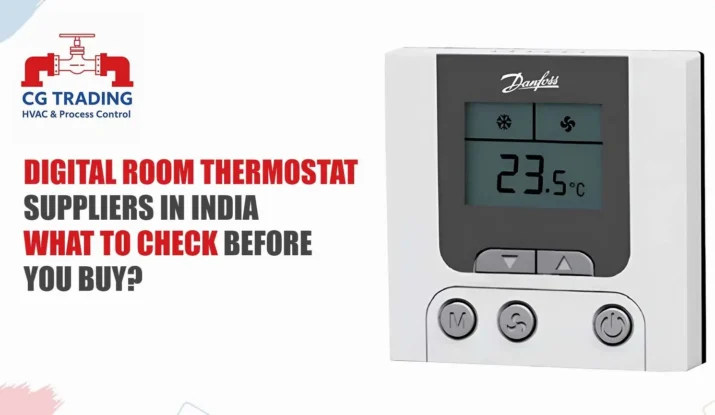
A digital room thermostat is a small wall-mounted control device that measures the air temperature in a room and controls heating or cooling equipment to keep it near the value you set. It has a digital display, so you can see the room temperature and the set temperature at a glance.Most people notice a thermostat only when something goes wrong. The room feels too hot or too cold, the bill goes up, or the equipment keeps switching on and off. A good thermostat avoids these problems quietly in the background.For hotels, hospitals, offices, shops and homes, it is one of the most useful and low-cost parts of a comfort and energy-saving system.Where Digital Room Thermostats Are Used
- Hotels and resorts: guest room air conditioning and fan coil units.
- Hospitals and clinics: comfortable and stable room conditions.
- Offices and commercial buildings: zone-wise temperature control.
- Homes and apartments: heaters, split units and underfloor heating.
- Schools and institutions: classroom and hall comfort.
- Server and electrical rooms: keeping equipment within a safe range.
- HVAC contractors and panel builders: as a standard control part in their systems.
Things to Check Before Buying a Thermostat
1. Match It with Your Application
Start with what you want to control. A thermostat made for a fan coil unit may not suit an electric heater, and one made for a heater may not control a cooling system.- Is it used for heating, cooling or both?
- Does the equipment need a simple on-off signal or a modulating signal?
- What is the supply voltage, such as 24 V or 230 V?
- Does the fan need three-speed control?
2. Accuracy and Control Quality
- Sensor accuracy: how close the displayed reading is to the real temperature.
- Setting range: it should suit your climate and use.
- Adjustable differential: a small, adjustable value gives steadier control.
- Calibration option: helpful if a small correction is needed on site.
3. Features That Really Matter
Do not pay for features you will never use. Pick those that solve your real problem.- Heating, cooling and auto modes.
- Fan speed control for fan coil systems.
- Programmable schedule for offices and institutions.
- Key lock to stop children or guests from changing settings.
- Frost protection for cold areas.
- Output options, such as relay, analog or communication, if the thermostat has to connect to a building system.
- Backlit display, which helps in dim rooms.
- Smart or Wi-Fi control, if remote use is important.
4. Build Quality and Safety
The relay is the part that fails first in a poor thermostat.- Check the relay rating, such as 16 A at 230 V, and compare it with your load. For heavy loads, use a contactor along with the thermostat.
- Look for flame-retardant plastic and a firm, well-fitting body.
- Ask for test reports, safety standard compliance and the relay life cycle.
- Check that the terminals are strong and clearly marked.
- Press the buttons yourself to feel their quality.
5. Installation Fit and Documentation
Small details save a lot of time at the site.- Does the size fit your standard wall box?
- Is there a clear wiring diagram on the unit and in the manual?
- Are the terminals easy to wire?
- Is there a back plate and screws in the pack?
- Is a user manual provided, in simple language?
How to Judge a Thermostat Supplier
The supplier matters as much as the product, especially for bulk orders. A low price means little if units fail early or the supplier disappears after delivery.- Manufacturer or trader: a manufacturer can handle quality issues and design changes more directly.
- Samples and test reports: a good supplier lets you test a unit under real load before a large order.
- Consistency: the first sample and the five-hundredth unit should perform the same.
- Warranty and support: clear written terms, and a quick response to faults and replacements.
- Customisation: your own branding, packaging or small design changes for large orders.
- Lead time and minimum order quantity: realistic, and put in writing.
- Price clarity: the quote should say what is included, such as taxes, packing and delivery.
- References: customers in hotel, HVAC or panel-building work can tell you how the product holds up over time.
Questions to Ask a Supplier
- Which equipment is this model made for?
- What is the sensor accuracy and the differential?
- What is the relay rating, and its life cycle?
- What safety tests and certificates are available?
- Is a sample available?
- What is the warranty period?
- What is the delivery time for my quantity?
- Can you provide custom branding?
Red Flags to Avoid
- A price far below the market, with no clear reason.
- No sample, no test report and no written quotation.
- Vague answers about relay rating, accuracy or certification.
- Unbranded parts with no technical details.
- No warranty terms and no service contact.
- Stock photos only, with no real product images.
- Pressure to pay the full amount before any paperwork.
- A specification on the quote that differs from the unit you receive.
- No manual or wiring diagram in the pack.
Conclusion
A well-chosen digital room thermostat in the right place can serve for many years with almost no attention. HVAC contractors, hotel and hospital projects, panel builders and distributors often order thermostats in large numbers. In such cases, it helps to work directly with a reliable manufacturer and supplier who can keep the quality the same across the batch and support you after delivery. If you are looking for a dependable partner for temperature control products, CG Trading supplies high-quality products in standard as well as customized models.Frequently Asked Questions
Can a digital room thermostat control an air conditioner?
Yes, if it is made for cooling and matches the equipment. It is commonly used with fan coil units and some other cooling systems.
Where should a room thermostat be installed?
On an inside wall at about eye level, away from sunlight, drafts, heaters and kitchens.
What is the differential in a thermostat?
It is the small gap between the switch-on and switch-off temperatures. It prevents the equipment from switching on and off too often.
Do I need a contactor with a thermostat?
If the equipment load is higher than the thermostat’s relay rating, yes. A contactor handles the heavy current, and the thermostat controls the contactor.
Why is my digital thermostat not switching on the equipment?
Check the mode, the setpoint, the power supply and the wiring. If the relay still does not work, the unit may be faulty.
How do I choose a digital room thermostat supplier in India?
Prefer a manufacturer who offers samples, test reports, a clear warranty and good after-sales support. Compare the full offer, not only the lowest price.