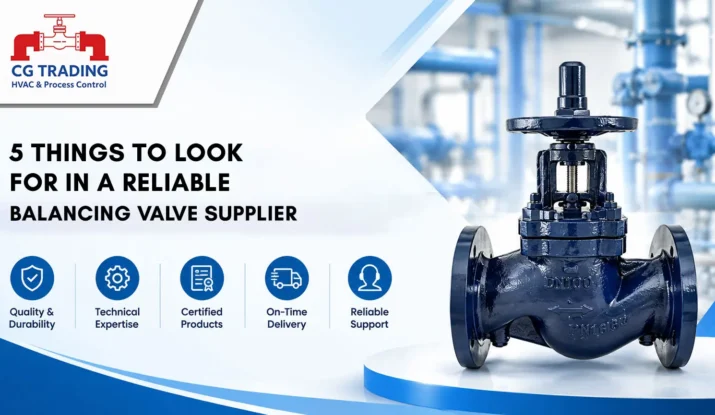
Overview – A balancing valve looks like a small, simple part sitting somewhere in an HVAC pipeline, but the wrong one, or one bought from the wrong supplier, can throw off the flow across an entire building. Uneven heating in some rooms, extra load on the pump, and higher power bills, these problems often trace back to a balancing valve that was not suited to the job or not installed correctly. This blog lists five things worth checking before you settle on a supplier for this part.
This blog covers:
Introduction
A balancing valve does one simple job: it controls how much water flows through a particular branch of a system so that every part of the building gets its fair share instead of the nearest branch pulling all the flow. Getting this part right matters more in a large system than people usually expect, since one badly balanced branch can mean cold rooms on one floor and overheated rooms on another, even though the boiler or chiller is working exactly as it should. Picking the right supplier is where this starts.The Range of Balancing Valve Types on Offer
Not every job needs the same kind of balancing valve, so the first thing worth checking is whether a supplier actually stocks a proper range rather than just one or two models.A manual balancing valve is set once during commissioning and stays at that setting, which suits systems where flow needs do not change much over time. An automatic version adjusts on its own as system conditions change, useful in buildings where flow demand varies through the day. A thermal water balancing valve responds to temperature changes rather than just flow, which is handy in domestic hot water systems where preventing scalding or bacterial growth matters as much as balancing the flow itself. A supplier who only carries one type is not always able to recommend the option that actually fits your system, so a wider range is a good early sign.
Build Quality and Material
The body material and construction of a balancing valve decide how well it holds up over years of use, not just how it performs on day one.A cast iron body, sturdy internals, and a positive shut-off design are the basics worth checking, since a valve that leaks slightly even when closed defeats the purpose of having precise control in the first place. High accuracy matters too, since a valve that cannot hold a consistent flow reading makes the whole balancing exercise pointless. Ask the supplier directly about the accuracy rating and shut-off performance of the valve rather than assuming every model on their shelf performs the same way.Brand Backing and Certification
A valve from a known, established brand generally comes with better documentation, easier spare parts availability, and a track record you can actually check.Reliable Balancing Valve Suppliers usually work with recognized names such as Danfoss, Honeywell, or similar established manufacturers, rather than unbranded imports with no clear origin. This matters when something goes wrong years later and you need a replacement part that actually fits, or when a consultant or client specifically asks for a particular brand on a project. A supplier who can show you datasheets, certification, and clear brand backing for every valve they sell is generally a safer choice than one who cannot.
Sizing and Technical Support
Getting the size and setting of a balancing valve wrong is one of the most common reasons a system does not balance properly even after installation, so technical support from the supplier matters as much as the product itself.A good HVAC balancing valve supplier should be able to help you work out the right size and setting based on your actual pipe diameter, flow rate, and system layout, rather than just selling whatever size you ask for. This kind of support becomes especially useful on larger projects with multiple branches, where a small sizing mistake on one valve can throw off the balance of the whole floor. If a supplier cannot answer basic technical questions about flow rate or pressure drop for their own product, that is worth noting before you place an order.
After-Sales Support and Availability
A balancing valve that fails or needs recalibration years after installation is only useful if the supplier who sold it is still around and able to help.Check whether the supplier keeps stock of spare parts and common models, rather than needing weeks to source a replacement from overseas. A supplier who has been in business for a good number of years and can be reached easily by phone or email, rather than only through a form on a website, generally gives you more confidence for long-term support. This becomes particularly important for an HVAC balancing valve used in a commercial building, where downtime affects tenants or operations, not just one household.
Source Your Valves From CG Trading
CG Trading, based in Surat, Gujarat, supplies balancing valve models from established brands, including Danfoss, Honeywell, and Advance Valves Group, covering manual, automatic, and thermal types for HVAC and industrial applications. With over 14 years of experience supplying valves and actuators across India, the team can help you choose the right size, type, and setting for your system instead of pushing a single standard model for every project.Frequently Asked Questions
What is the difference between a manual and an automatic balancing valve?
A manual valve is set once the pump is put into service and stays at that setting unless someone manually adjusts it again, while an automatic valve adjusts on its own as flow or pressure conditions in the system change.
Why does a badly balanced HVAC system waste more power than a properly balanced one?
When some branches get more flow than they need, the pump has to work harder to push water through the whole system, and other branches end up under-supplied, which often leads to extra heating or cooling being run to compensate.
How do I know what size balancing valve my system needs?
The right size depends on pipe diameter, required flow rate, and the pressure drop your system can accommodate, and this is exactly the kind of calculation a good supplier’s technical team should help you work out rather than leaving you to guess.
Do balancing valves need regular maintenance after installation?
Yes, periodic checking of the setting and a visual inspection for leaks or wear is generally recommended, especially in commercial systems where consistent flow across the building matters for both comfort and running cost.